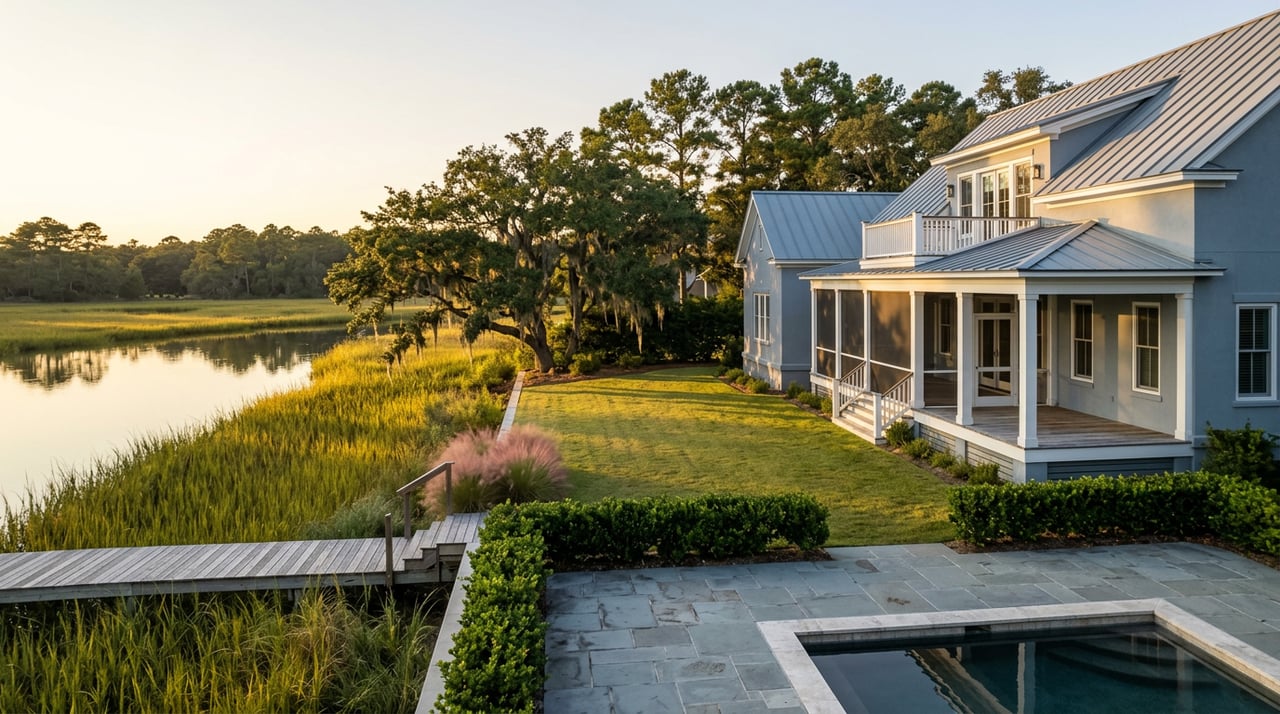
"It's really spectacular to see," Joe Newton says of the evening ritual outside his back door. Every night during nesting season, hundreds of ibises settle onto a small island of trees in Otter Creek. Every morning, they lift off together. Joe and his wife Shirley have a front row seat from their patio, wine in hand, at what has quietly become one of Indigo Run's least advertised features: a working rookery, tucked behind lagoons and golf fairways, that most people on the island have never heard of.
This spring that secret got loud. A proposed townhome development on the far bank of the creek has residents asking the Town of Hilton Head to step in. But the story being told around Indigo Run right now, that a peaceful bird sanctuary is suddenly under threat from a new project, misses the part that actually matters most to anyone who has watched this creek for more than a season or two. The rookery has been losing ground for nearly a decade already. The fight over Driftwood isn't the beginning of that story. It may be the last chance to slow it down.
A Secret With No Recorded Age
Nobody in Indigo Run can say how old the rookery is. It sits on a tiny stand of trees in Otter Creek, close enough to the Newtons' backyard that they can hear the birds before they see them. During nesting season the island fills with spoonbills, egrets, herons, and wood storks, all raising chicks within feet of each other. Roseate spoonbills, in particular, are a relatively new addition. The species is native to Florida, and warming coastal waters have pushed them steadily north in recent years, making Otter Creek one of the more unlikely places on Hilton Head Island to spot their pink feathers.
Wildlife photographer Bill Bosley has documented the site for years and describes it as one of the densest concentrations of wading birds he has seen outside a dedicated preserve. For residents who happen to live along that stretch of Broad Creek frontage, it has functioned as a private, unmarked sanctuary. No signage, no boardwalk, no parking lot. Just a small island that fills with life every spring and empties out by fall.
The Turn Nobody Noticed at the Time
Here is the part of the story that gets lost when the conversation jumps straight to the new development plans. Susan Martin, another local wildlife photographer, has been visiting the rookery for more than 15 years. Her read on its trajectory is not that Driftwood put the rookery at risk. It's that the rookery has already been thinning out, and has been since Hurricane Matthew tore through the Lowcountry in 2016.
That storm reshaped tree cover and shoreline habitat across the island, and Otter Creek's rookery was not spared. Martin has watched bird activity decline noticeably in the years since, well before any developer filed paperwork for the parcel across the water. That timeline matters. It means the real question facing this stretch of Indigo Run isn't whether a new project will damage a pristine, untouched habitat. It's whether what remains of an already-stressed rookery can absorb one more disruption, or whether Driftwood becomes the push that finishes what Matthew started.
What's Actually Proposed at 229 Marshland Road
The project itself has a name, an address, and a paper trail. Charleston-based Material Capital Partners is proposing a 58-unit, long-term-rental townhome community at 229 Marshland Road, just across the creek from the nesting island. The company bought the northern portion of the site for $7.2 million in February 2026, while the southern lot remains with the heirs of the original owner. Plans include a pool, clubhouse, gathering pavilion, and stormwater drainage areas, and Hilton Head-based architecture firm Wood+Partners submitted conceptual site plans to the town on May 13.
David McNair, a resident who has followed the project closely, points to a name most Hilton Head residents recognize: Charles Fraser, the Sea Pines developer credited with the environmentally conscious planning that shaped the island's original character. McNair's concern is that the site plans leave only a thin buffer of trees between the new buildings and the creek bank, close enough that Bosley has described construction noise and lighting landing "just 10 yards across the creek" from active nests. Martin's assessment is blunt: without a real buffer left intact, the disturbance from people, lights, and noise would be enough to finish driving the birds off the island for good.
Material Capital Partners isn't new to this kind of project locally. The same firm developed Indigo Cove, a build-to-rent townhome community in Bluffton off Bluffton Parkway near Buck Island Road, which gives some indication of the density and rental model likely to appear at Marshland Road as well.
The Park That Already Exists as a Model
Residents pushing back on Driftwood aren't just asking the town to say no. They're pointing to a specific alternative that already exists less than 20 minutes away. Cypress Wetlands in Port Royal is a public park built around its own rookery, with a boardwalk that lets visitors watch nesting birds without disturbing them. Bosley has floated a version of the same idea for the Otter Creek site: a small parking area and a walking trail, enough infrastructure to let birdwatchers and kayakers enjoy the rookery without threatening it.
That's not a hypothetical the town has never acted on. Hilton Head runs a land-purchase program funded in part through a tax on real estate transfers, and according to an October 2025 town news release, it has spent more than $44.6 million on property acquisitions since 2023. That spending prevented construction of 424 dwelling units, along with hotel rooms and commercial space, across the island. It's a real track record, not a wish list, and it's the strongest argument residents have for asking the town to consider the same move here.
The review process for Driftwood is still working through its steps. A public comment period with the South Carolina Department of Environmental Services closed in early June, and the project still needs to clear the town's Design Review Board, which evaluates how new construction fits the look and feel the town has spent decades protecting. One reviewer's written comment on the project put the underlying concern plainly: disturbed wetland and nesting habitat may never fully recover once construction begins.
What This Looks Like From the Trail This Fall
For residents who walk Indigo Run's leisure trails or bike past Sunningdale Park in the evening, the practical effect of all this won't show up as a headline. It will show up, or fail to show up, in whether next spring's nesting season looks anything like the ones before it. The birds don't know about site plans or design review meetings. They'll come back if the creek still feels safe enough, and they won't if it doesn't.
What makes Otter Creek's rookery worth paying attention to isn't that it's rare in the abstract. It's that it has survived this long as an accident, unmarked and unprotected, inside a community that never set out to build a bird sanctuary in the first place. Whether it survives the next few years depends less on Driftwood alone and more on whether anyone steps in to give it the kind of buffer that Hurricane Matthew already took away.
If you're weighing a move to Indigo Run, or already call Broad Creek frontage home and want a clearer read on how neighborhood decisions like this one tend to unfold on the island, the team at Herman and Davis has spent decades watching these conversations play out. Reach out any time you want a local, straight answer.